

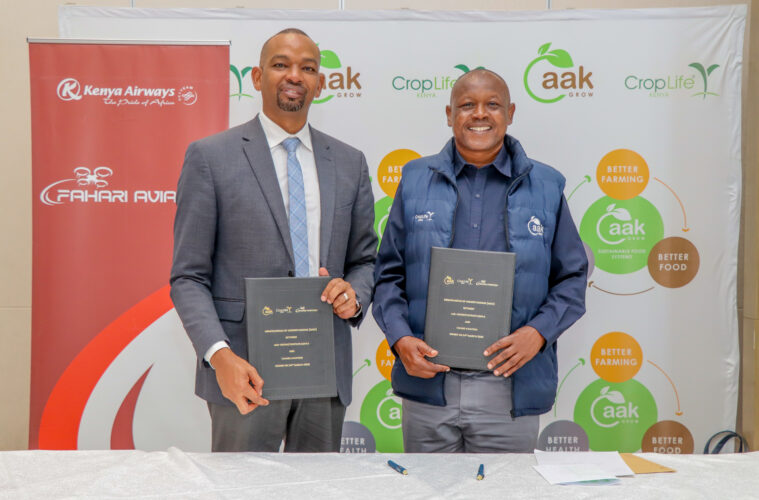
Fahari Aviation, a subsidiary of Kenya Airways (KQ), and aak-GROW/CropLife Kenya have officially entered into a strategic partnership. The two organizations signed a Memorandum of Understanding (MOU) on April 15, 2026, aimed at accelerating the adoption of drone-enabled precision agriculture throughout the country.
The partnership is built on the strengths of two industry leaders. Fahari Aviation brings its specialized drone operations and aerial data analytics to the table, while aak-GROW/ CropLife Kenya provides the necessary framework for safety training and regulatory compliance.
“This partnership reflects our commitment to leveraging drone technology to enhance agricultural productivity while prioritizing safety and sustainability,” stated Mr. Hawkins Musili, General Manager of Fahari Aviation. “By empowering farmers with innovative tools, we are contributing to a more resilient and future-ready agricultural sector.”
Mr. Joel Mutai, Acting CEO of aak-GROW/CropLife Kenya, echoed this sentiment, emphasizing the health benefits of the deal: “By combining innovation with strong stewardship, we can support farmers in improving productivity while safeguarding their health and the environment.”
The MOU outlines a comprehensive roadmap to integrate drone technology into the daily lives of Kenyan farmers. The collaboration will focus on several pillars:
- Research & Development: Jointly exploring new ways to optimize crop yields.
- Training & Capacity Building: Educating farmers and agronomists on how to operate and benefit from drone tech responsibly.
- Policy Engagement: Working with regulators to develop international-standard policies for safe drone use.
- Technology Integration: Merging drones with Artificial Intelligence (AI) and satellite imagery for hyper-precise mapping and application.
Benefits to the agricultural value chain
The shift from manual spraying to drone-based application is expected to yield immediate results for the Kenyan agricultural sector:
| Feature | Impact on Farmers |
| Precision Application | Reduced input costs and minimized chemical runoff. |
| Worker Safety | Significantly lower direct exposure to hazardous pesticides. |
| Environmental Impact | Reduced carbon footprint compared to traditional machinery. |
| Data Accuracy | Improved traceability and accountability in farming practices. |