

For many living in Kenya, business isn’t a corporate strategy, it’s a daily battle for survival. It is the immediate difference between a meal on the table and an empty cupboard.
It is here, in the trenches of everyday life, that the I&M Foundation is rewriting the rules of corporate social investment. Established in 2020, the Foundation is powered by a sustainable shared value model. Funded by a permanent annual endowment of 2% of I&M Bank Kenya’s Profit Before Tax (PBT), the Foundation possesses the long-term funding required to act as the architect of generational resilience.
The Foundation strategy is anchored across four interconnected pillars, Education & Skills Development, Environmental Conservation, Economic Empowerment, and Enabling Giving. This enables it to target the triple bottom line of People, Planet, and Profit. But its true heartbeat lies within its Economic Empowerment initiatives, where structural change is built from the ground up, one human story at a time.
Take the women behind the Maa Beadwork initiative in the Greater Mara Ecosystem. For generations, their intricate, culturally rich handicraft was profoundly undervalued, sold at the whim of predatory middlemen who pocketed the lion’s share of the profit.
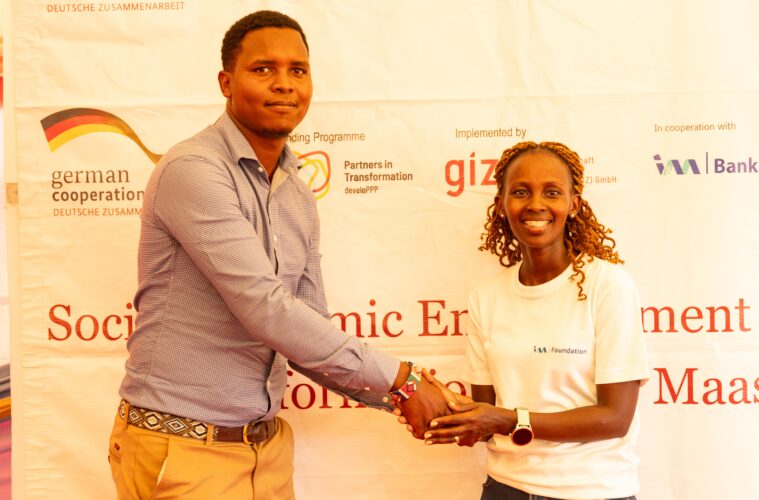
The I&M Foundation, in a landmark Ksh. 230 million joint partnership with the German Development Agency (GIZ) and implemented by The Maa Trust, chose to dismantle this dynamic. They didn’t just offer financial aid; they brought these women into a commercial ecosystem. Today, over 570 Maasai women are mastering quality control, competitive pricing, and international supply chains.
To foster localized innovation, the partnership launched The Predators’ Den, a grassroots entrepreneurship challenge. Out of 140 applicants from across seven Mara communities, 21 finalists underwent intensive business mentorship, culminating in a live pitch competition where nine youth and women-led eco-enterprises were awarded Ksh. 1.92 million in direct seed funding.
In Nairobi, the scenery changes, but the economic battle remains identical. For a young person navigating the streets, the barrier to breaking the cycle of poverty is often as simple as a lack of equipment. You cannot start a car wash without a pressurized pump; you cannot run a small grocery kiosk without physical infrastructure.
Through the Jenga Bizna Mtaani program, launched in partnership with the Jonathan Jackson Foundation, the I&M Foundation deploys a profoundly practical intervention: providing tangible tools of trade. The program equips young entrepreneurs with food carts, car wash machines, and micro-kiosk setups. This effectively transforms a vulnerable youth from a frustrated job seeker into an active job creator. Suddenly, they have a tangible stake in their local economy.
Across both rural and urban programs, the Foundation actively sustains and strengthens over 115 women-led self-help groups. In these groups, the acute stress of financial volatility is collectivized and mitigated. If an individual member faces a sudden medical emergency or a business setback, the group acts as an institutional shock absorber. By building internal micro-savings, table-banking, and localized lending structures, the Foundation helps families manufacture their own safety nets.
The I&M Foundation has realized that you do not truly empower people by doing things for them. You empower them by providing the exact tools, technical knowledge, and institutional confidence required to do it themselves. In doing so, they are fueling a powerful revolution across Kenya, one small business, one artisan, and one harvest at a time.