

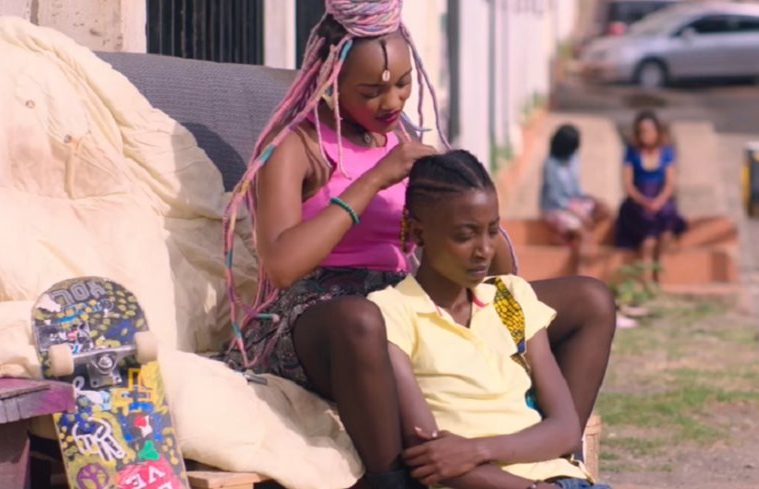
In a significant ruling for the creative industry and constitutional law, the Court of Appeal at Nairobi has partially overturned a High Court decision regarding the controversial 2018 ban of the film Rafiki.
The judgment, delivered by Justices W. Karanja, Tuiyott, and Achode, navigates the delicate balance between the freedom of artistic expression and the state’s power to regulate public morality.
The journey of Rafiki is one of extreme highs and lows. In April 2018, the film made history as the first Kenyan feature film to screen at the prestigious Cannes Film Festival. Inspired by the Caine Prize-winning story Jambula Tree, the film was celebrated globally as a groundbreaking piece of African cinema.
However, the domestic reception was starkly different. On April 27, 2018, the Kenya Film Classification Board (KFCB), led by CEO Ezekiel Mutua, officially banned the film in Kenya. The Board claimed the film’s producer, Wanuri Kahiu, declined to remove “offensive classifiable elements” and argued the film sought to “normalize homosexuality” contrary to Kenyan law.
In September 2018, Kahiu and the Creative Economy Working Group (CEWG) sued the KFCB, challenging the constitutionality of the ban. They argued that colonial-era laws were being used to stifle modern artistic creativity.
On September 21, 2018, Justice Wilfrida Okwany issued a landmark conservatory order, temporarily lifting the ban for seven days. This was critical to allow the film to be considered by the Oscars Selection Committee for the Best Foreign Language Film category.
Between September 23 and 29, 2018, Kenyans flocked to Prestige Cinemas and other venues. The film proved to be a massive commercial success, grossing Ksh. 3.3 million in just seven days with over 6,500 viewers. Despite this public interest, the High Court dismissed the main petition in 2020, ruling that the ban was constitutional and that Kahiu had failed to exhaust all administrative appeal options.
While the legal battle moved to the Court of Appeal, Rafiki continued to win accolades abroad:
- March 2019: Lead actress Samantha Mugatsia won the Best Actress award at the FESPACO Film Festival in Burkina Faso.
- October 2019: The film won two awards at the Africa Movie Academy Awards (AMAA) for Best Achievement in Editing and Best Film in an African Language.
The Court of Appeal’s key findings
The appellate court’s recent ruling addressed three primary pillars: jurisdiction, the constitutionality of the Film and Stage Plays Act, and the proportionality of the ban.
1. On Jurisdiction and “Exhaustion”
The Court of Appeal disagreed with the High Court’s refusal to hear the case fully. It ruled that while statutory appeal mechanisms (like Section 29 of the Act) exist, they are inadequate when a citizen is challenging the constitutionality of the law itself.
“The Minister has no power to declare any law as unconstitutional,” the judges noted, affirming that the High Court was the correct forum for a “genuine and bonafide grievance.”
2. Unconstitutional “Excesses” in the Law
While the Court upheld the general right of the State to regulate films, it struck down two specific provisions of the Film and Stage Plays Act as unconstitutional:
- Section 9(1): The court nullified the power of police officers to use force to stop film scenes unless there is an immediate danger to safety or cruelty to animals. Using force simply to enforce licensing conditions was deemed a violation of rights.
- Section 16(3): The court struck down the provision allowing the Board to physically “seize and retain” excised parts of a film, calling it an unnecessary interference with property rights.
3. The “Rafiki” Ban: Depiction vs. Promotion
The most nuanced part of the judgment addressed the ban itself. The Court made a landmark distinction between depicting a lifestyle and promoting illegal acts.
- The Proportionality Test: The Court ruled that if a film merely depicts a homosexual lifestyle without “glamorizing or promoting” it, an outright ban is a disproportionate limitation on freedom of expression.
- The Verdict: The Board’s reasoning—that the film contained “homosexual practices”—might justify an “Adults Only” rating, but not necessarily a total ban. A ban is only permissible if the film actively advocates for or glorifies conduct that is currently criminalized.
The court highlighted how other democratic nations handled the film to illustrate the concept of “less restrictive means”:
| Country | Rating/Status |
| France | Universal (All ages) |
| Germany | 12+ |
| South Africa | 16+ |
| Kenya | Banned (Restricted) |
Ultimately, the Court of Appeal did not immediately lift the ban but provided a clear legal pathway for the filmmaker. The court ordered:
- Partial Victory: Sections 9(1) and 16(3) of the Act are officially null and void.
- Right to Appeal: Wanuri Kahiu is granted 30 days to appeal the KFCB’s original 2018 decision to the Cabinet Secretary.
- New Guidelines: Any future review must distinguish between “depiction” (which requires rating) and “promotion” (which may justify restriction).
Find the full judgment HERE.