

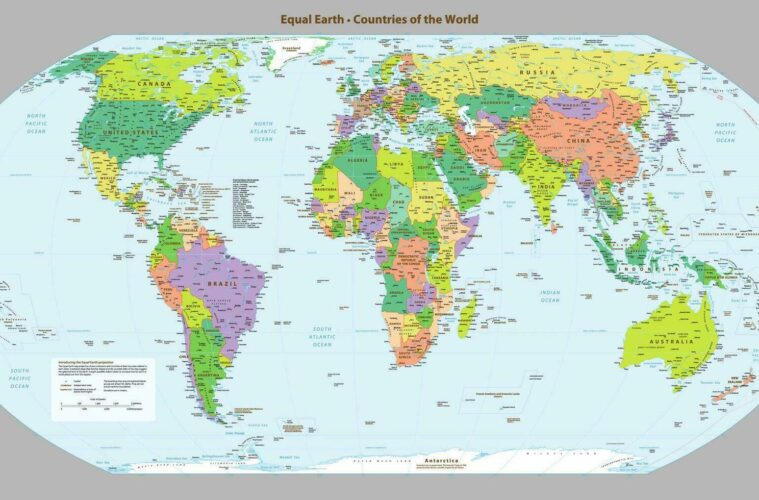
In a historic move during its 39th Ordinary Session, the Assembly of the African Union (AU) has officially moved to dismantle centuries of cartographic invisibility. By adopting a landmark decision to overhaul how the continent is represented in media, education, and geospatial systems, the AU is prioritizing the Equal Earth projection as the new global standard.
This initiative aligns with the AU’s 2025 theme, Justice for Africans and People of African Descent Through Reparations, and serves as a cornerstone of Agenda 2063. It is a direct effort to reclaim the African narrative and ensure the continent’s physical and geopolitical stature is accurately reflected worldwide.
For centuries, the Mercator projection has been the dominant map in classrooms and newsrooms. While useful for navigation, it creates a stretching effect near the poles, making Africa appear significantly smaller than it is.
The Reality of Africa’s Scale:
- Actual Landmass: ~30.37 million km².
- The Discrepancy: Despite being the second-largest continent, traditional maps often depict Africa as roughly the same size as Greenland (which is actually 14 times smaller).
- The Impact: These distortions have subtly influenced global policy, infrastructure investment, and environmental governance by diminishing Africa’s perceived importance.
“We need a new political map of Africa that shows its true size and place in the world,” stated Professor Robert Dussey, Togo’s Minister of Foreign Affairs. “Fair representation is essential for global awareness and geopolitical understanding.”
The Assembly’s resolution outlines a clear path toward cartographic justice:
- Standardization: Official adoption of the Equal Earth projection for a proportionate global view.
- Educational Reform: Encouraging Member States to update school curricula to reflect accurate landmasses.
- Economic Realities: Acknowledging that visual distortions have historically undermined the perception of Africa’s economic and developmental potential.
- Cultural Identity: Linking map accuracy to the African Renaissance and the 9th Pan-African Congress’s calls for narrative sovereignty.
- Leadership: Appointing a dedicated Champion to oversee the implementation and reporting of these changes across the continent.
The shift is a major win for the Correct the Map campaign, a collaborative effort by Africa No Filter and Speak Up Africa. It represents more than just a technical change; it is an act of symbolic reparation.
Moky Makura, Executive Director of Africa No Filter, highlighted the stakes:
“Accurate representation is not just about maps; it is about agency, progress, and ensuring the world sees Africa as it truly is—vast, significant, and central.”