

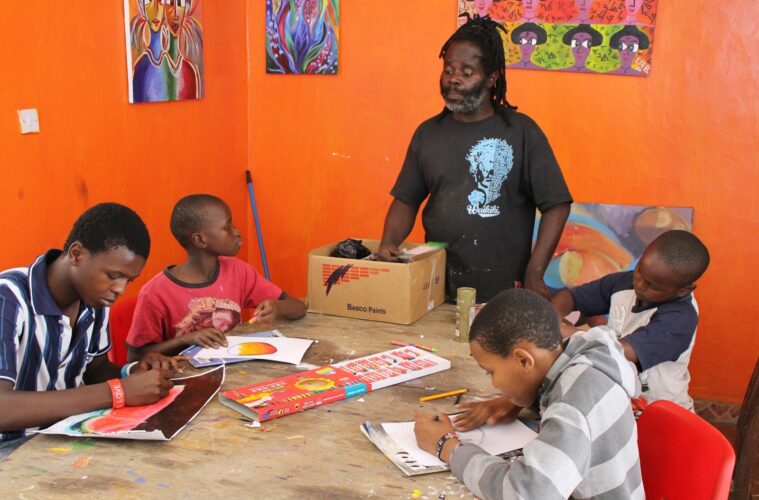
Nairobi has lost its most vibrant mirror. With the passing of Patrick Mukabi, the city loses more than just a painter; it loses a chronicler of its heartbeat, a mentor to its youth, and a man whose brushstrokes defined the visual identity of the Kenyan middle class.
Mukabi, affectionately known as “Panye,” passed away at Kenyatta National Hospital following a courageous battle with diabetes, a struggle that saw him face amputation and intensive care, but never managed to dim his creative spirit. He leaves behind a city that is visually richer for his presence but structurally poorer for his absence.
Born in Nairobi in 1969 as the fourth of seven children, Mukabi’s artistic journey was rooted in the very infrastructure of the city. Inspired by Catholic imagery and encouraged by his father, a Kenya Railways employee, he eventually set up his legendary studio, Dust Depo, right beside the old Railway Museum.
After earning a certificate in graphic design from the Technical University of Kenya (formerly The Kenya Polytechnic University College), Mukabi bypassed the rarefied air of elite galleries to bring art to the people. His style was unapologetically democratic:
- Medium: Primarily acrylic on canvas.
- Focus: The human figure, specifically women in the ordinary commerce of life.
- Technique: Visible layers and transparent processes that mirrored his own open personality.


To most Kenyans, Mukabi was the silent guest at every coffee date. His iconic paintings of robust, kanga-clad women became the hallmark of Java House across the country. These weren’t idealized figures; they were celebrations of resilience.
Whether it was his “Market Women” series, depicting traders with baskets balanced on their heads, or his later “Cover Girls” collection celebrating fuller-figured women, Mukabi saw majesty where others saw only the mundane.
For those of us in the media, we remember how Mukabi memorialized the 1998 US Embassy bombing. In a moment of national trauma, he used his art to provide a space for mourning and memory, proving early on that he was a national treasure.
Over the years, I followed his work closely, watching him transition from a painter of canvases to a painter of a generation. He wasn’t just an artist; he was a teacher.
Mukabi’s generosity was legendary. At Dust Depo, he ran an open-door academy where aspiring artists found materials and wisdom in equal measure.
- Saturday Mornings: He taught children’s classes, some televised as Uncle Supuu on Citizen TV.
- Mentorship: He taught toddlers to slather paint like jam on bread, and many of Kenya’s rising stars passed through his hands.
- The Barefoot Philosopher: He famously worked barefoot in his studio, claiming he couldn’t think with shoes on.
Despite his international acclaim, exhibiting in over 20 countries, Mukabi’s final years were a stark reminder of the precarity facing Kenyan icons. Fellow artists had to organize benefit exhibitions like “Mali Safi” just to cover his mounting medical bills.
Kenya owes him a great debt of gratitude, but gratitude doesn’t pay for healthcare. His passing should serve as a catalyst for institutional change. We urgently need an Arts Council to recognize, protect, and support artists of his caliber, as well as other cultural figures.
Patrick Mukabi painted abundance where others saw only survival. Today, as we sit in cafes surrounded by his self-assured, luminous women, we must ensure his legacy leads to a future where our makers are valued as much as their masterpieces.
Rest in Power, Panye. Your colours will never fade.