

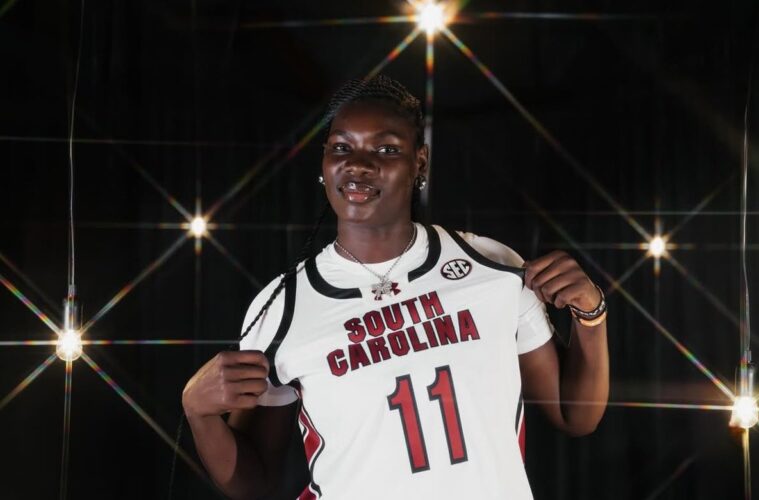
For decades, the global sporting identity of Kenya has been synonymous with the rhythmic stride of marathoners and the golden triumphs of the track. But in 2025, a new narrative was written on the hardwood. When Madina Okot heard her name called at the WNBA Draft, it wasn’t just a career milestone; it was a seismic shift for East African basketball.
Okot’s selection makes her the first Kenyan-born player to be drafted into the Women’s National Basketball Association, shattering a long-standing barrier and placing Kenya firmly on the professional basketball map.
Standing at 6’6″, Okot has long been a towering figure in the African basketball circuit. Before catching the eyes of international scouts, she dominated the local scene with Zetech Sparks and Kenya Ports Authority (KPA). Her journey is a testament to the homegrown talent flourishing within the Kenyan Premier League.
Her rise was accelerated by stellar performances in the FIBA Africa Champions Cup, where she consistently outperformed seasoned internationals, proving that her height was matched only by her high basketball IQ and tenacity on the glass.
WNBA scouts have lauded Okot for a skill set that translates perfectly to the modern professional game. As a double-double threat, her impact is felt most heavily in the paint:
- Rim Protection: Her wingspan and timing make her one of the most feared shot-blockers to emerge from the continent in recent years.
- Rebounding Prowess: Okot possesses a natural instinct for positioning, often out-muscling opponents to secure second-chance opportunities.
- Mobile Size: Unlike traditional stay-at-home centers, Okot displays the lateral quickness necessary to defend pick-and-roll situations, a requirement in the fast-paced WNBA.
The significance of Okot’s breakthrough extends far beyond her individual statistics. For young athletes in Nairobi, Mombasa, and Kisumu, the WNBA is no longer a distant American dream—it is a tangible reality.
Her success is expected to trigger a wave of interest from US college recruiters and professional scouts looking toward East Africa, a region previously overshadowed by West African basketball powerhouses like Nigeria and Senegal.