

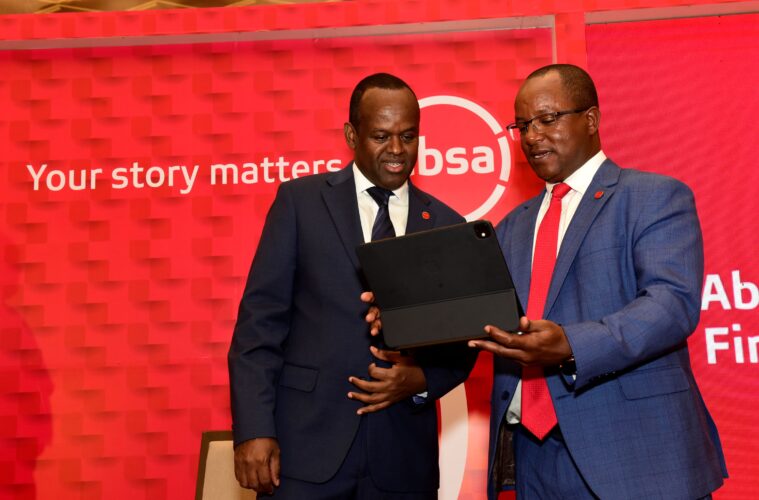
Absa Bank Kenya PLC has announced that it has posted a net profit of Ksh. 5.3 billion for the first quarter ending March 31, 2026. This is a contraction from the Ksh. 6.16 billion net profit the bank posted in the same period in 2025.
Despite shifting market dynamics and a prevailing lower interest rate environment, Absa expanded its balance sheet, driven by sustained customer trust and deliberate execution of its strategy.
Financial performance overview
| Financial Metric | Q1 2025 | Q1 2026 | Year-on-Year Change |
| Profit After Tax (Net Profit) | Kshs. 6.16 billion | Kshs. 5.30 billion | -13.9% |
| Total Assets | Kshs. 520.6 billion | Kshs. 571.3 billion | +9.7% |
| Customer Deposits | Kshs. 371.2 billion | Kshs. 399.1 billion | +7.5% |
| Loans and Advances | Kshs. 308.4 billion | Kshs. 303.8 billion | -1.5% |
| Return on Equity (RoE) | 27.0% | 20.3% | -6.7% |
Key Financial Highlights (Q1 2026)
- Total Assets: Increased by 10% year-on-year to reach Ksh. 571.3 billion.
- Customer Deposits: Grew by 8%, closing at Ksh. 399.1 billion.
- Loans and Advances: Closed at Ksh. 303.8 billion, reflecting the bank’s ongoing commitment to funding households, individuals, and businesses.
- Total Revenue: Stood at Ksh. 14.7 billion, supported by disciplined cost-of-funds management.
- Income Split: Net interest income accounted for Ksh. 10.4 billion, while non-interest income closed at Ksh. 4.3 billion.
“It has been a demanding period for our customers and the broader economy, but our focus has been on standing alongside those we serve,” said Abdi Mohamed, Absa Bank Kenya PLC Managing Director and CEO. “While our performance reflects these pressures, our actions are guided by a long-term view, supporting our customers today while safeguarding the strength of our business for the future.”
A bright spot in the bank’s revenue diversification agenda was its subsidiary ecosystem, which registered a 25% year-on-year growth in total income, cushioning the lender against core interest rate fluctuations.
Revenue Stream Breakdown
| Revenue Component | Q1 2025 | Q1 2026 | Context & Core Drivers |
| Net Interest Income | Kshs. 11.3 billion | Kshs. 10.4 billion | Impacted by a lower interest rate environment |
| Non-Interest Income | Kshs. 4.5 billion | Ksh. 4.3 billion | Softened by lower FX trading volumes vs 2024/2025 highs |
| Total Operating Revenue | Ksh. 15.8 billion | Ksh. 14.7 billion | Down 7.1% due to asset yield compressions |
| Subsidiary Revenue Growth | Baseline | Noted Component | Up 25% YoY, offsetting core balance sheet pressures |
Absa’s localized approach across its business segments yielded measurable commercial success during the quarter:
1. Private and personal banking
The retail segment scaled its wealth offerings and enhanced its premium propositions, notably through its leading platinum card. These efforts earned Absa the title of Best Retail Bank Kenya 2026.
2. Business banking (MSMEs)
The bank focused heavily on supply chain financing. Through the WEZESHA value-chain programme, the Lipa na Absa digital merchant payment solution, and dedicated business credit cards, Absa improved critical working capital access for MSMEs. Furthermore, the bank re-launched and strengthened its Asset-Based Finance (ABF) proposition in April 2026 to offer more asset solutions.
3. Corporate and investment banking
Absa consolidated its market-leading position, ranking first in East Africa for Mergers & Acquisitions (M&A) by deal value. This was supported by a strong sector coverage model and bespoke corporate mandates. Concurrently, the Global Markets unit diversified earnings by introducing new currency pairs and expanding non-funded income streams.
Beyond core banking, Absa leveraged high-profile stakeholder and community platforms to sustain market relevance and drive inclusive growth.
The bank used major sporting events, including the Magical Kenya Open, Absa Sirikwa Classic, and Absa Kip Keino Classic, as strategic touchpoints to deepen client relationships and engage key economic ecosystems.
On the sustainability front, the newly established Absa Kenya Foundation made a significant social impact by launching the CirculaRising programme. The initiative has already supported over 2,000 women and youth-led MSMEs within the circular economy, with the potential to positively impact more than 30,000 livelihoods.