

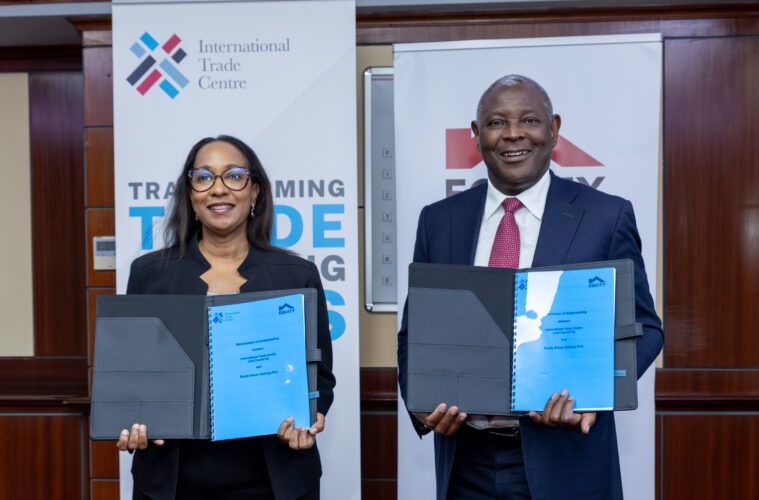
The International Trade Centre (ITC) and Equity Group Holdings PLC have announced that they have signed a Memorandum of Understanding (MoU). The partnership aims to drive inclusive, commercially viable development by equipping small businesses with the financial backing and technical expertise needed to compete on the global stage.
The agreement marries ITC’s extensive global trade development expertise with Equity Group’s massive pan-African financial footprint. Initially launching with a pilot phase in Kenya running through December 2026, the initiative is designed to scale rapidly, with plans to expand into other East African markets beginning in 2027.
The strategic collaboration will focus heavily on three high-potential sectors:
- Coffee
- Leather
- Creative Industries
“We know that access to finance is critical for small businesses – but it has to be matched with the right skills to use it effectively,” said Pamela Coke-Hamilton, ITC Executive Director. “That’s why we’re partnering with Equity Bank – to ensure small businesses across East Africa can tap both financing and trade expertise to move up the value chain and compete in global markets.”
The initiative integrates directly with Equity Group’s Africa Recovery and Resilience Plan (ARRP), a robust six-pillar regional growth strategy that spans food and agriculture, manufacturing, MSMEs, technology, and social impact investments. With banking subsidiaries in the Democratic Republic of Congo, Kenya, Rwanda, South Sudan, Uganda, and Tanzania, Equity Group provides the regional infrastructure necessary to scale the project.
Dr. James Mwangi, Managing Director and CEO of Equity Group, emphasized that the partnership is about transforming small businesses from passive trade participants into market leaders.
“Through our Africa Recovery and Resilience Plan, we are intentionally investing in sectors that create jobs, expand exports, and drive inclusive economic transformation,” Dr. Mwangi stated. “By combining access to finance, trade intelligence, capacity building, and market linkages, we are building an ecosystem that enables MSMEs in coffee, leather, and the creative economy to scale sustainably and compete globally.”
The partnership has outlined distinct, actionable roadmaps for each of its target industries to address specific bottlenecks and regulatory hurdles.
1. Coffee
Building upon the European Union-funded Market Access Upgrade Programme (MARKUP) II, the ITC will roll out practical training sessions between June and September 2026. The training will focus on:
- Export logistics and price risk management.
- Specialty coffee quality and advanced processing techniques.
- EUDR Compliance: A critical component will involve helping producers navigate the stringent requirements of the European Union Deforestation Regulation (EUDR), ensuring that East African coffee exports face no friction entering European markets.
2. Leather
To move away from exporting raw hides and toward exporting finished goods, the partnership will support the midterm review of the EAC Leather and Leather Products Strategy 2020–2030. Key initiatives include:
- Product design coaching for footwear MSMEs.
- Harmonizing quality standards across East African Community (EAC) Partner States.
- Onboarding local businesses onto global e-commerce platforms like Etsy, eBay, and Shopify to bridge the gap to international consumers.
- Ensuring leather products also meet the upcoming EUDR environmental standards.
3. Creative industries
Recognizing the massive economic potential of culture and digital media, the collaboration will target music, film, gaming, digital media, performing arts, fashion, and crafts. The rollout will follow a phased approach:
- Phase 1: Sector mapping and comprehensive market assessments.
- Phase 2: Implementation of tailored business development support, market access initiatives, and specialized financial solutions.
Beyond sector-specific training, the collaboration provides participating businesses and Equity Group staff with institutional support. Entrepreneurs will gain access to ITC’s suite of trade market intelligence tools and the SME Trade Academy, ITC’s premier online learning platform.