

For decades, traditional conservation models in the Greater Mara Ecosystem inadvertently placed local communities at odds with wildlife. Communities bore the brunt of human-wildlife conflict while seeing little of the financial windfall generated by luxury tourism. When economic survival is a daily battle, communities are often pushed toward environmentally unsustainable practices, such as charcoal burning, overgrazing, or land subdivision.
Today, conservationists are realizing a fundamental truth that to protect the wild, you must first empower the people. By fostering local entrepreneurship, organizations are creating a sustainable economic buffer that turns Maasai youth and women from passive bystanders into active guardians of their natural heritage.
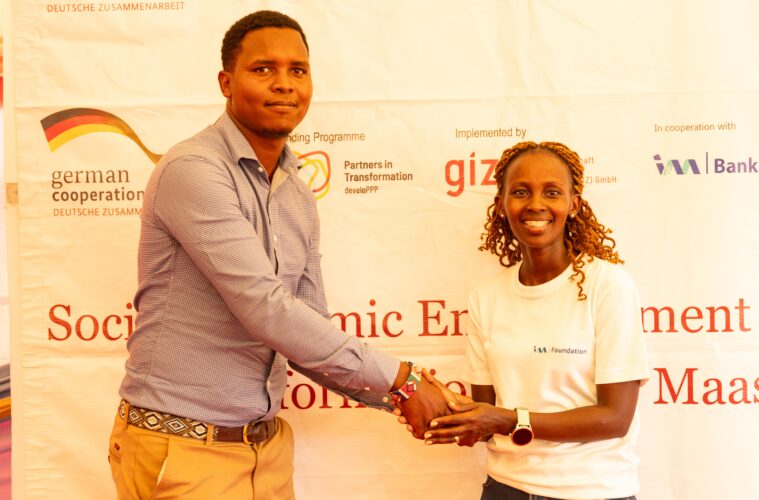
A prime example of this innovative intersection is the Economic Empowerment and Gender Transformation in the Maasai Mara programme. Backed by a Ksh. 230 million joint commitment from the I&M Foundation, I&M Bank, and Germany’s GIZ (through the develoPPP programme), this initiative directly links financial independence with environmental stewardship.
Implemented on the ground by The Maa Trust, the initiative recently culminated in an entrepreneurship challenge aptly named The Predators’ Den.
Mirroring the format of the hit television show Shark Tank, the Predators’ Den provided a stage for local Maasai youth and women to pitch their grassroots business ideas to a panel of judges. Hundreds of applicants from Narok County entered the program, undergoing intensive training in business development, financial literacy, and pitching, followed by months of mentorship.
Ultimately, nine standout entrepreneurs walked away with a combined Ksh 1.92 million in seed funding, alongside business scholarships and incubation support. The winning business concepts showcase a community pivoting toward sustainable, climate-resilient commerce:
- Eco-Friendly Solutions: Finalists pitched ventures spanning clean energy, localized small-scale manufacturing, eco-agriculture, and vital water services.
- Localized Production: The competition’s overall winner, Carl Naurori, secured funding to scale a local bakery venture. By producing essential goods within the community, ventures like Naurori’s reduce reliance on carbon-heavy, long-distance supply chains while creating immediate green jobs.
The ripple effect on conservation
When a Maasai youth or woman runs a profitable, independent business, their household’s financial stability is decoupled from activities that degrade the environment. A family with a steady stream of entrepreneurial income is less likely to engage in retaliatory wildlife killing, overstock fragile communal lands with cattle, or clear indigenous forests.
Furthermore, because these businesses thrive in an ecosystem supported by eco-tourism and global conservation funding, the community begins to view wildlife not as a threat, but as an economic asset worth preserving.
A blueprint for the future
The success of the Predators’ Den demonstrates that protecting Africa’s biodiverse landscapes does not mean restricting human progress. Through strategic partnerships between corporate foundations, international development agencies, and local trusts, entrepreneurship is proving to be the missing link in modern conservation.
By investing in the minds and ambitions of the Maasai Mara’s residents, the I&M Foundation and its partners are proving that the best way to safeguard the wild is to ensure that the people living alongside it have the tools to thrive.