

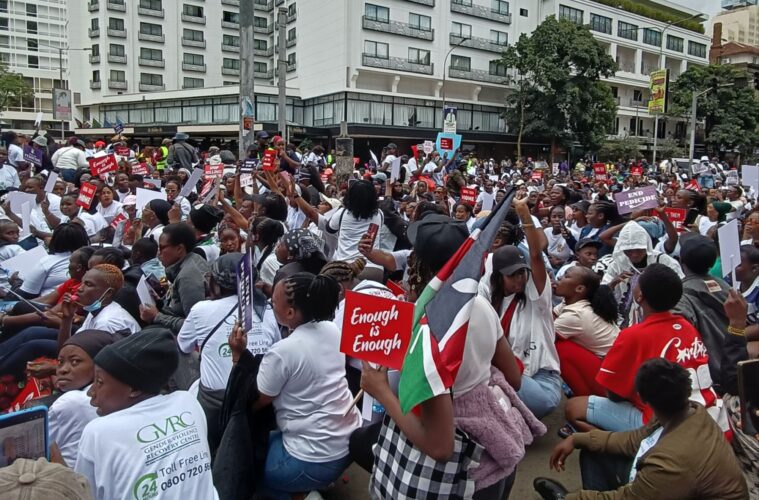
The atmosphere at Jevanjee Gardens on Monday June 1 was heavy, charged with a profound mixture of grief, exhaustion, and defiance. Hundreds gathered for the End Femicide March, a peaceful protest organized by human rights organization Usikimye alongside other civil society groups, to demand urgent action against the skyrocketing cases of femicide and pedicide in Kenya.
The demonstration underscored a harrowing reality: women and children in Kenya are facing an unprecedented crisis of violence, predominantly at the hands of men.
Moving with disciplined order, the procession marched from the historic Jevanjee Gardens through the streets of Nairobi to Kenyatta Avenue, halting near the Sarova Stanley hotel. The marchers carried symbols that laid bare the human cost of systemic failure:
- The Wall of Shame: A devastating, physical registry bearing the names of the women and children whose lives have been brutally cut short.
- Ceremonial Coffins: Striking, somber visual reminders of the souls lost to a crisis that advocates argue is not being treated with the urgency it deserves.
The sheer indignity of having to march for the basic right to survive was not lost on those present. Yet, the dignity and discipline of the crowd sent a clear message to the state: the public will not look away, even if the authorities do.
@covaw_kenya 63 years ago, Kenya claimed Madaraka – power, authority, the promise of a republic built on dignity and freedom for all its people. That promise has never fully reached our women, who are being killed in their homes, on their streets, by the very people meant to love and protect them. We are still watching women be murdered. Still watching a justice system shrug. Still watching perpetrators walk free. Still being told it was her fault; what she wore, where she went, who she loved… Still being told to mourn quietly and move on. Every week, another name. Another daughter, sister, mother, wife – her story stolen. Her future erased. Not today! This Madaraka Day we don’t celebrate. We grieve, we rage, and we march. Because Madaraka means nothing if women are not free to exist safely in their own homes, streets, and bodies. Stop killing us! EndFemicideKE EndFemicide EndGBV MadarakaDay NotOneMoreName JusticeForWomen
While the energy of the march was undeniable, it also highlighted a glaring societal gap. The overwhelming majority of the participants were women.
Femicide and pedicide are often mischaracterized as “women’s issues,” a dangerous narrative that leaves the burden of survival and justice entirely on the victims. Because men are overwhelmingly the perpetrators of this violence, advocates at the march stressed that men must be the ones to step up and dismantle it.
True male allyship cannot be passive. It requires men to:
- Show up physically to support these movements.
- Call out violent behaviors, misogyny, and toxic dynamics in their own social circles.
- Actively share the burden of demanding accountability from leadership.
Despite continuous pressure from human rights groups and alarming statistics regarding Gender-Based Violence (GBV), government intervention remains agonizingly slow. The policy shifts and legislative protections required to treat femicide as a distinct, high-priority crime are bogged down by administrative delays.
Monday’s march was a powerful reminder that the status quo is lethal. The organizers and participants made it clear that they will not stop taking to the streets until the authorities pay attention, enact sweeping reforms, and guarantee safety for Kenya’s women and children. Every name on that wall of shame represents a systemic failure, and a vow that they will not be forgotten.