

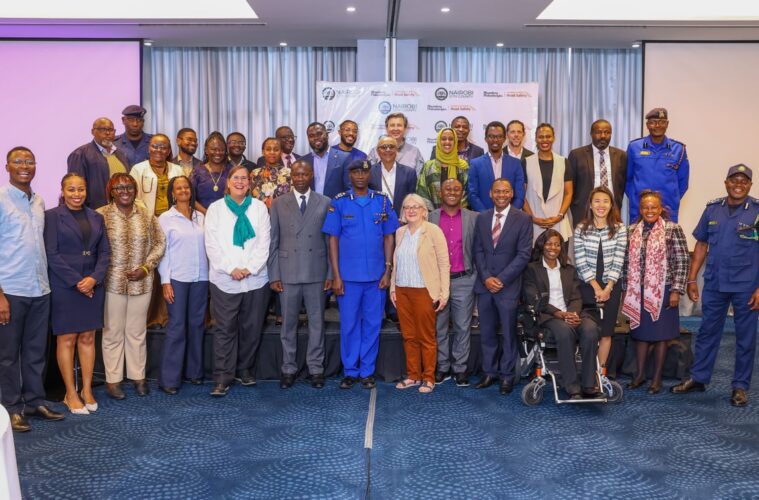
The Nairobi City County Government has officially joined the Bloomberg Philanthropies Initiative for Global Road Safety (BIGRS).
Nairobi joins a network of more than 30 global cities participating in the initiative. The partnership is funded through a $350 million global commitment announced by Mike Bloomberg at CityLab 2026 in April, aimed at preventing traffic deaths and injuries worldwide.
In Kenya alone, traffic incidents kill over 4,000 people annually, with Nairobi County accounting for approximately 560 of those deaths. An additional 20 to 50 million people worldwide suffer injuries, many resulting in lifelong disabilities.
Crucially, experts and policymakers emphasize that these incidents are rarely accidents. Instead, they are the predictable results of systemic failures, including poorly designed roads and public policies that historically prioritized vehicular speed over public health and safety.
To combat this, the BIGRS initiative focuses on embedding the “Safe System Approach” into urban planning. This methodology accepts that humans make mistakes and designs infrastructure to ensure those mistakes are not fatal.
Speaking during the official kickoff meeting, Nairobi Governor Johnson Sakaja welcomed the partnership, framing it as a critical milestone for the rapidly growing capital.
“We are delighted to be part of the Bloomberg Philanthropies Initiative for Global Road Safety,” Governor Sakaja said. “As the capital city of Kenya, Nairobi serves a large and rapidly growing population, making this collaboration both timely and critical. This partnership will greatly strengthen our ongoing efforts to protect and safeguard the lives of Nairobi residents.”
The collaboration will inject international technical expertise into Nairobi’s planning sectors. Under the initiative, the city will receive specialized support across three critical pillars:
- Infrastructure Redesign: Expanding connected cycling paths, upgrading pedestrian walkways, and transforming high-risk corridors.
- Speed Management: Strengthening enforcement initiatives to reduce speeding, a factor currently linked to nearly 50% of road traffic fatalities globally.
- Data and Monitoring: Enhancing local data collection to make evidence-based decisions and accurately track the impact of new traffic interventions.
By joining the initiative, Nairobi enters a collaborative learning network spanning 13 countries. The city will share data, strategies, and successes with major global hubs, including:
| Region | Participating Cities & States |
| East Africa | Nairobi, Mombasa (Kenya); Kampala (Uganda); Oromia State (Ethiopia) |
| Latin America | Buenos Aires (Argentina); São Paulo, Rio de Janeiro (Brazil); Medellín (Colombia); Mexico City (Mexico) |
| Asia | Delhi, Mumbai (India); Dhaka North (Bangladesh); Kuala Lumpur (Malaysia); Hanoi (Vietnam) |