

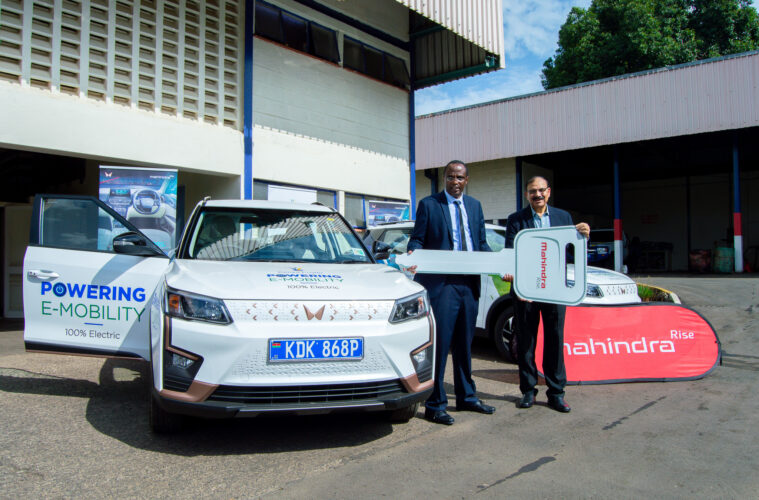
The electric vehicle (EV) revolution in Kenya is no longer just a futuristic concept or a localized pilot project, it has officially shifted into high gear.
According to newly released data from Kenya Power’s E-mobility Sales Growth Analysis Report, the utility firm has raked in a cumulative Ksh. 382 million in e-mobility revenue over a 34-month period between July 2023 and April 2026. This financial surge underscores an unprecedented acceleration in the adoption of electric transit across the country.
The numbers tell a story of exponential momentum. In July 2023, monthly revenues from EV charging stood at a modest Ksh. 873,907. Fast forward to February 2026, and that figure peaked at a staggering Ksh. 35.25 million per month.
This financial trajectory mirrors a massive volume growth in electricity consumption. In less than three years, electricity sales to the e-mobility sector grew 113-fold, skyrocketing from a mere 13,500 kWh in July 2023 to more than 1.5 million kWh in April 2026. A key historic milestone was crossed in November 2025, when monthly sales breached the 1 million kWh mark for the first time, a threshold the sector has consistently maintained ever since.
While the capital city remains the undisputed hub of the green transition, the data reveals that the EV wave is steadily spreading to other regions:
| Region | Revenue Generated (July 2023 – April 2026) | Share of Total Revenue (%) |
| Nairobi | Ksh. 271.9 Million | ~71% |
| Coast | Ksh. 55.0 Million | ~14% |
| North Eastern | Ksh. 35.0 Million | ~9% |
| West Kenya | Ksh. 11.5 Million | ~3% |
Kenya Power’s Managing Director and CEO, Dr. (Eng.) Joseph Siror, emphasized that the data proves EVs are firmly embedded in the mainstream market, prompting a shift in corporate strategy to support nationwide infrastructure.
“Our E-mobility Sales Growth Analysis Report shows that electricity sales to the e-mobility sector have grown 113-fold in just under three years… This is clear evidence that EV adoption is no longer a pilot, but a mainstream reality,” noted Dr. Siror. “This growth tells us the opportunity is truly national, and our focus must be on diversifying beyond the capital.”
Data from the Electric Mobility Association of Kenya (EMAK) backs up this shift, indicating that Kenya’s registered EV fleet surpassed 35,000 vehicles by the end of 202, dominated heavily by electric two-wheelers, up from just 796 vehicles three years prior.
This rapid ecosystem expansion has been heavily supported by government policy, including the zero-rating of VAT on EVs and lithium-ion batteries, alongside reduced excise duties on electric motorcycles and bicycles. Kenya Power anticipates that these incentives will continue to drive growth as the country marches toward its goal of universal electricity access by 2030.
Kenya Power, in partnership with GIZ Kenya, EMAK, and the Kühne Foundation, has flagged off long-distance EV parades. These vehicle convoys are traveling from Nairobi to Mombasa, and Nairobi to Kisumu, to rigorously test the readiness and reliability of the charging infrastructure along Kenya’s major highway corridors.
As part of this initiative, Kenya Power is expanding its footprint and leading by example through several key deployments:
- New Charging Hubs: The immediate launch of brand-new, company-operated EV charging stations located at Kenya Power offices in Voi and Nyali, Mombasa.
- Corporate Fleet Greening: The rollout of e-bikes for use by Kenya Power’s own meter readers stationed in Nakuru and Mombasa Island, embedding sustainable transport directly into the utility’s daily operations.
These landmark findings serve as the opening act for the upcoming 4th Annual Kenya Power E-mobility Stakeholders’ Conference and Expo, scheduled to take place from 4–5 June 2026 at the Kenyatta International Convention Centre (KICC) in Nairobi.
More than 1,000 regional stakeholders, policymakers, and innovators from across East Africa are expected to convene under the theme: Aligning Policy, Infrastructure Development and Partnerships to Scale E-mobility in Kenya. The event promises to be a vital crucible for the next phase of policy drafting, infrastructure investments, and tech showcases destined to shape the next decade of clean transport in the region.