

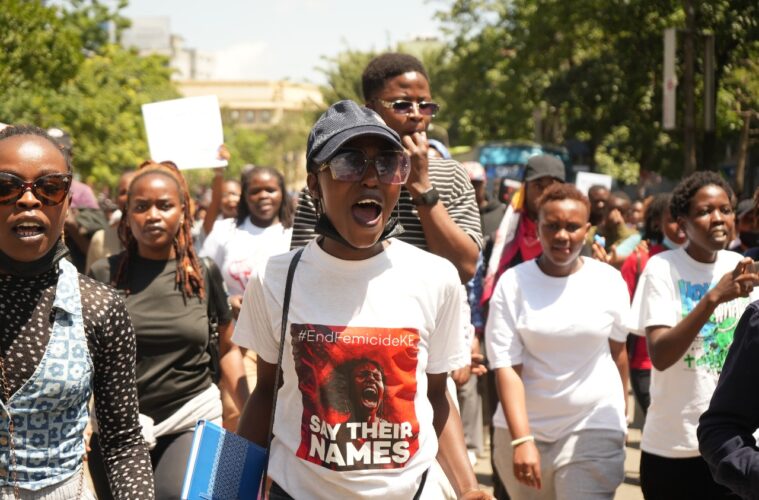
A coalition of Kenya’s leading human rights, legal, and student organizations has issued a scathing joint statement, declaring that violence against women and girls (VAW/G) has reached catastrophic, unprecedented levels.
The collective includes the Federation of Women Lawyers in Kenya (FIDA-Kenya), the Law Society of Kenya (LSK), and the Kenya Human Rights Commission (KHRC). They are demanding immediate state intervention, giving President William Ruto’s administration a strict 40-day window to act before taking to the streets and the courts.
The faces of the crisis
The joint statement paints a grim picture of the realities facing Kenyan women, grounding its systemic critique in a series of recent, horrific tragedies that have shocked the nation:
- Sylvia Kemunto: A first-year student at Multimedia University, found strangled to death in a water tank with signs of having fought for her life.
- Anita: Fatally stabbed by her husband—a senior Kenya Defence Forces officer—in front of their four-year-old daughter and house manager.
- Rose Benter Apondi: A 21-year-old student at the Ramogi Institute of Advanced Technology, murdered by her ex-boyfriend in a planned revenge attack.
- Rachel Wandeto: A popular gospel musician who recently succumbed to horrific injuries at Kenyatta National Hospital after being doused in petrol and set on fire by unknown attackers.
“We are deeply troubled by the daily reports of women being killed in horrific ways—some have been assaulted and murdered, some attacked with corrosive chemicals, others dismembered, and their bodies discarded without dignity,” the statement reads.
STATEMENT: If these demands are not met, it will demonstrate a lack of commitment and accountability on the part of duty bearers. If there is no action within the next 40 days, we will organise peaceful protests across the country and file a Strategic Interest Litigation (SIL) pic.twitter.com/RZP2CmMEac
— FIDA-Kenya (@fidakenya) May 20, 2026
The grim statistics
According to data compiled by civil society and international watchdogs, the domestic sphere has become increasingly perilous for young Kenyan women. The coalition highlighted several devastating metrics:
| Source | Findings & Statistical Impact |
| FIDA-Kenya (2026 Data) | 50% of all weekly cases handled across its three national offices (35 out of 70) are directly tied to intimate partner violence. |
| Amnesty International Kenya | At least 8 femicide cases are reported each week, averaging one woman killed every single day across the country. |
| National Demographics | Young women aged 18 to 35 make up 59% of all national femicide cases, with students in higher education bearing the brunt of the crisis. |
The groups strongly critiqued the current legal framework, pointing out that femicide is still not recognized as its own distinct crime under Kenyan law. Instead, these targeted killings are routinely categorized as general homicides, masking the gender-based motives behind the violence and stalling accurate data collection.
Systemic failures and Government inaction
The coalition expressed deep frustration with the state’s slow apparatus. While acknowledging that President Ruto established a Technical Working Group on Gender-Based Violence which launched a comprehensive report on January 26, the groups noted that its key recommendations have gathered dust.
Furthermore, the statement highlighted a fatal breakdown in community and police protection systems. In the vast majority of recent fatalities, victims had explicitly reported prior abuse, shared their fears, or sought intervention from families, local leaders, and police, only to be ignored or directed toward informal dispute resolution mechanisms.
The six demands for the next 40 days
To halt the wave of violence, the coalition has laid out six non-negotiable demands for immediate implementation:
- Declare a National Crisis: President Ruto must officially declare GBV and femicide a national crisis, unlocking emergency state funding and resources.
- Publish a Status Report: The Ministry of Gender, Culture, the Arts and Heritage, alongside the Ministry of Interior, must immediately release a progress report on the Technical Working Group’s recommendations.
- Operationalize a Dedicated GBV Fund: Establish a secure, state-backed national budget for survivor support, rescue shelters, and prevention programs.
- Deploy Rapid Response Systems: Establish trauma-informed, one-stop response centers providing legal, medical, and psychosocial aid in high-prevalence counties.
- Launch a National Awareness Campaign: Roll out a nationwide campaign to dismantle cultural myths fueling violence and conduct an expansive, evidence-based GBV prevalence survey.
- Enforce Police Accountability: The National Police Service must immediately introduce specialized units trained in handling gender-based crimes, evidence preservation, and international human rights standards.
What happens next?
The organizations have made it clear that the time for passive dialogue has expired. If the government fails to demonstrate measurable action on these six points within the next 40 days, the coalition will launch two major pushbacks:
- Nationwide Protests: Organizers will mobilize peaceful, grassroots-led demonstrations across all 47 counties, pulling in civil society, male champions, and the wider public.
- Strategic Interest Litigation (SIL): Legal bodies within the coalition will sue the state to legally compel the government to uphold its constitutional mandate to protect the lives and dignity of its citizens.