

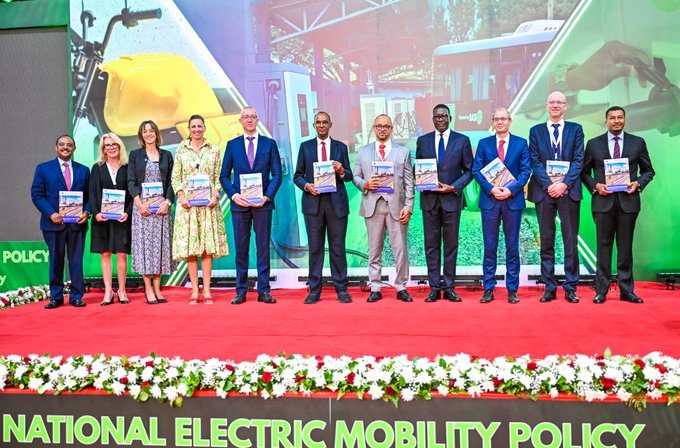
The Government of Kenya has officially launched the National Electric Mobility Policy (National e-Mobility policy). This strategy aims to transition the country toward a cleaner, more efficient, and low-carbon transport system.
The policy was unveiled at the Kenyatta International Convention Centre (KICC) by the Cabinet Secretary for Roads and Transport, Mr. Davis Chirchir, EGH.
Between 2022 and 2025, Kenya witnessed a staggering 2,700% increase in electric vehicle (EV) registrations, jumping from 1,378 to 39,324 units. The boda boda (motorcycle taxi) sector has led this charge, facilitated by asset financing and a growing appetite for affordable green technology.
To celebrate this milestone, the CS also launched green reflective number plates, specifically designated for 100% electric vehicles, providing a distinct identity for zero-emission transport on Kenyan roads.
To ensure the policy translates into reality, the Government has integrated aggressive tax incentives through the Finance Bill 2025:
- VAT Zero-rating: Applies to electric buses, electric bicycles, electric motorcycles, and lithium-ion batteries.
- Zero Excise Duty: Eliminated for electric bicycles, electric motorcycles, and batteries.
Beyond taxes, the government is mandating infrastructure growth. New building guidelines now encourage (and in some cases require) commercial developments to set aside at least 5% of parking spaces for EV charging.
The National E-Mobility Policy provides a framework for all modes of transport. By leveraging Kenya’s abundant renewable energy, the government aims to modernize the sector, reduce greenhouse gas emissions by 32% by 2030.
Find the National Electric Mobility Policy HERE.