

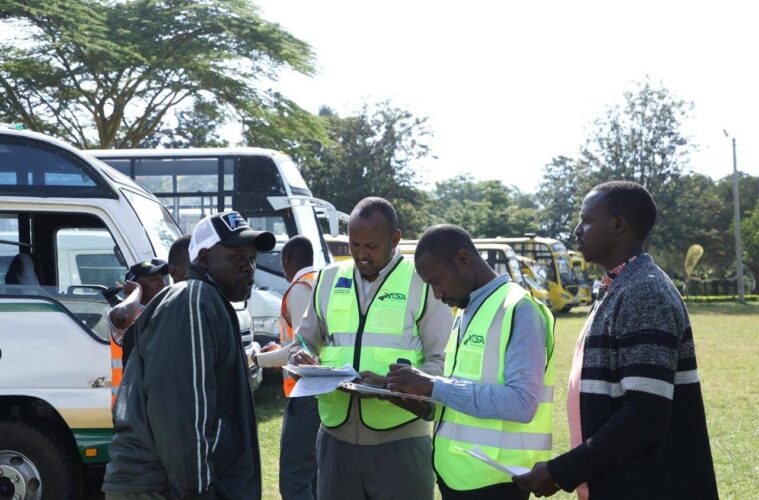
As of June 1st, 2026, the National Transport and Safety Authority (NTSA) has officially operationalized an enforcement framework designed to digitize minor traffic offenses.
This was done in collaboration with the National Police Service (NPS), the Judiciary, the Office of the Attorney General, and the Office of the Director of Public Prosecutions (ODPP).
Here is everything you need to know about how the new system works and what it costs if you are caught speeding.
How Offences are Detected and Served
Under this framework, motorists who commit any of the offenses listed in the Traffic (Minor Offences) Rules, 2016 will no longer need to appear in court immediately. Instead, violations are detected either by police officers during routine enforcement or captured electronically via traffic cameras and other digital monitoring systems.
Once sufficient evidence is gathered, a formal Police Notification of Traffic Offence is issued directly to either the driver or the registered vehicle owner. These notifications can be served in several ways, including:
- Personal delivery by police officers.
- Affixing the notice directly to the vehicle.
- Electronic delivery sent via SMS, email, or approved digital traffic enforcement platforms.
Because of this approach, motorists are strongly encouraged to ensure their contact details in the NTSA registration system are accurate and up to date.
The cost of speeding
The core penalties driving this new framework are derived directly from the First Schedule of Legal Notice 161 of 2016. Fines are tiered progressively based on how far above the speed limit a motorist is driving:
General Speed Limit Violations
(Applies to Section 42(1) and 43(1) regarding the prescribed speed limit for your specific class of vehicle)
- Exceeding by 1 to 5 kph: Warning (No monetary fine)
- Exceeding by 6 to 10 kph: Ksh. 500
- Exceeding by 11 to 15 kph: Ksh. 3,000
- Exceeding by 16 to 20 kph: Ksh. 10,000
Town / Sign-Posted Speed Limit Violations
(Applies to Section 42(3), (4) and 43(1) regarding the standard 50 kph limit in towns or limits explicitly shown on traffic signs)
- Exceeding by 1 to 5 kph: Warning (No monetary fine)
- Exceeding by 6 to 10 kph: Ksh. 500
- Exceeding by 11 to 15 kph: Ksh. 3,000
- Exceeding by 16 to 20 kph: Ksh. 10,000
The 20 kph threshold
It is crucial to note that the instant fine framework maxes out at 20 kph over the designated limit. If a motorist exceeds the speed limit by more than 20 kph, the violation is no longer considered a minor offence. It escalates to serious reckless driving, meaning the matter cannot be settled with a standard instant fine and the motorist will likely be required to appear in a regular traffic court.
Your legal options
Each notification contains key details such as the nature of the offense, the date, time, location it occurred, the prescribed penalty, payment instructions, and response deadlines. Upon receiving a notice, motorists have two primary options:
Option 1: Admit liability
Motorists can choose to admit liability and pay the prescribed fine within the stipulated period. If the motorist chooses to pay the fine, the matter can be settled without the need for a court appearance.
To combat roadside corruption, statutory rules dictate that bail in the form of hard cash is strictly prohibited; payments must be processed directly via the designated digital confirmation references or bank channels specified on the notification form.
Option 2: Dispute the allegation
If a motorist believes they were wrongly accused, they may dispute the allegation in court. Under this framework, motorists have the absolute RIGHT to access evidence, such as photographs or video recordings, supporting the alleged offense.
If you choose to dispute the charge, you will be assigned a date to attend Traffic Court and must provide a bail amount equal to the standard statutory penalty using non-cash channels. While the court retains the power to reduce or refund the penalty based on mitigating circumstances (if any), it also gains the authority to administer demerit points against the driver’s license where appropriate.
Failure to respond, pay fines, or appear in court when required may result in harsher penalties imposed directly by the courts.