

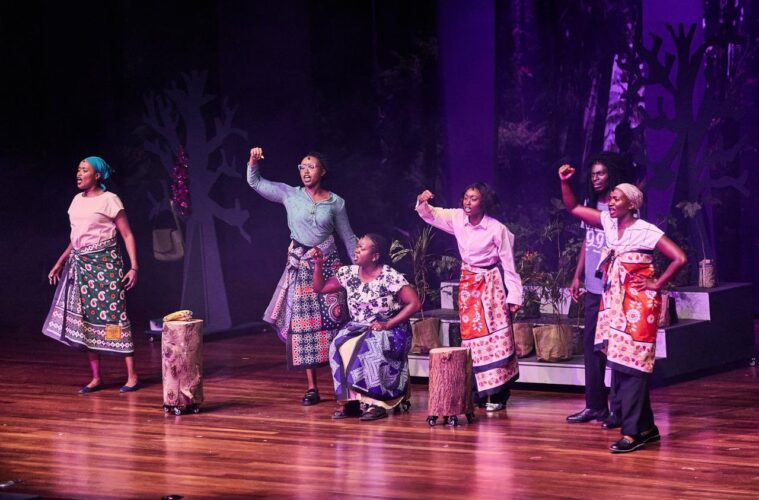
If there are three words that define the latest installment of Too Early for Birds (TEFB), they are fantastic, emotional, and masterful. Actually, three words aren’t nearly enough. The Wangari Maathai Edition, titled Shawry for Trees: The Roots of a Revolutionary, proved once again why Story Zetu remains the gold standard for Kenyan storytelling.
From the moment audiences arrived at the Jain Bhavan Auditorium in Nairobi this April, it was clear that the production value had reached a new zenith. Between the seamless parking and ticketing, the expanded outdoor seating, and the diverse array of vendors, the logistical execution was as sturdy as a Mũgumo tree.
The play opens with the high-water mark of Wangari’s career, receiving the Nobel Peace Prize, before weaving back into the genesis of her story. Using their signature sideshadowing technique, the writers, Abigail Arunga, Wacuka Mũngai, and Ras Mengesha, crafted a narrative that wasn’t just a biography of one woman, but a vibrant tapestry of Kenya’s soul.
The script fearlessly tackled:
- The Tom Mboya airlift program.
- The harrowing era of political assassinations and the 1982 coup.
- The oppressive one-party state under Moi’s presidency.
It felt like the history lesson we were always denied in school—truthful, raw, and unapologetically Kenyan.
Lead actress Akinyi Oluoch delivered a performance of clinical precision and immense heart. She didn’t just play a historical figure; she brought a baddie to life, showcasing Wangari as a mother, a professor, and a firebrand activist.
The aesthetic detail was equally striking. The costume department’s recreation of Wangari’s iconic orange kitenge was a nostalgic masterstroke, and the improved stage props grounded the performance in a tangible reality.
Despite being a historical piece, the play felt incredibly modern. By weaving in current cultural touchstones like “good morning from Kili” and “weka mawe,” the production mirrored the society of 2026. It reminded the audience that the battles Wangari fought against land grabbing and systemic injustice are far from over.
The music selection was, as expected, fabulous, serving as the heartbeat that guided the audience through a gauntlet of emotions, from gut-busting laughter to the heavy silence of empathy and frustration.
TEFB didn’t just put on a play; they used the stage as a shovel to dig to the roots of our identity. With ticket tiers named after indigenous trees, Mũkĩma and Mũgumo, and a Ballots to the Stage initiative encouraging civic engagement, the production lived up to the legendary activism of its subject.
The verdict is unanimous: We need a rerun. And if Story Zetu is listening, the audience is officially ready for a dedicated series on those assassination stories.
Too Early for Birds continues to prove that our history isn’t just a series of dates in a textbook, it is a living, breathing, and profoundly entertaining drama.