

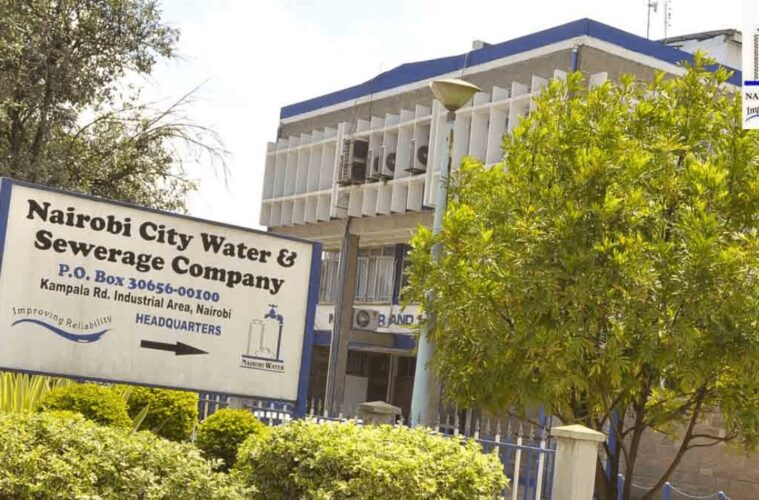
Households and businesses across Nairobi are set to experience an increase in their monthly utility costs following the approval of a new tariff structure for the Nairobi City Water and Sewerage Company (NCWSC).
The Water Services Regulatory Board (WASREB) officially sanctioned the upward review, which was detailed in a Kenya Gazette notice published on February 27, 2026. The new rates are scheduled to cover the financial years 2025/2026 through 2028/2029.
According to the regulator, the adjustment is necessary to enable NCWSC to modernize the city’s aging infrastructure, strengthen operational efficiency, and ensure a more reliable water supply. WASREB noted that the review followed an extensive process of stakeholder participation and public consultations as mandated by the Water Act of 2016.
“WASREB has determined that an upward tariff review is justified for NCWSC to improve service delivery, operate sustainably, and protect consumer interests,” the gazette notice stated.
The revised structure employs a graduated billing system where the cost per cubic meter increases based on total consumption. This approach is designed to encourage conservation while subsidizing low-volume users.
- Domestic/Residential Users: Consumers using between 1 and 6 cubic meters (m³) will be charged Ksh 68 per m³. This rate climbs significantly for higher usage, reaching Ksh 117 per m³ for those consuming more than 300 m³.
- Gated Communities: These will be billed at a flat rate of Ksh 85 per m³.
- Commercial and Industrial Entities: Rates start at Ksh 91 per m³ for the first 50 m³ and rise to Ksh 117 per m³ for consumption exceeding 300 m³.
- Educational Institutions: Public schools and universities will pay between Ksh 78 and Ksh 94 per m³, depending on volume.
In addition to the base water price, sewerage charges have also been adjusted. For customers connected to the city’s sewer system, the sewerage fee will now be calculated as 75% of the total water consumption bill. Consequently, any increase in water usage will lead to a proportional rise in sewerage costs.
Addressing concerns regarding infrastructure maintenance, the Gazette notice outlined a specific protocol for customers with non-functional water meters. Until such meters are repaired or replaced, these customers will be billed based on the average of their last three months of recorded usage.
The timing of these increases comes as many city residents are already grappling with a high cost of living. The immediate impact will be felt in the monthly budgets of thousands of small businesses and households across the capital.
The new tariffs are expected to be reflected in the next billing cycle following the gazette publication.