

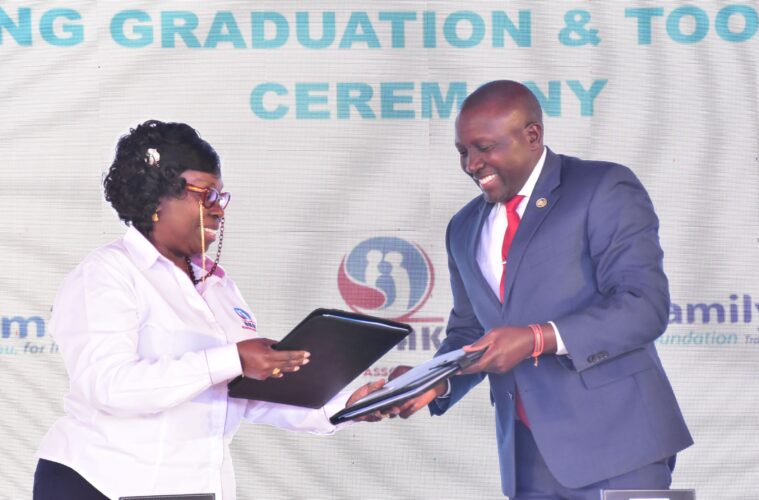
The Family Group Foundation has announced that it has signed a partnership agreement with the Military Wives Association of Kenya (MWAK).
The collaboration aims to institutionalize technical and vocational skills training for the dependents of Kenya Defence Forces (KDF) personnel, ensuring a sustainable path toward employment and entrepreneurship.
The announcement was made during the graduation of the program’s fourth cohort, where 89 young men and women from the Kenya Army celebrated their transition into the professional world at the Embakasi Garrison.
Since its inception, the initiative has successfully equipped 290 beneficiaries—primarily dependents of service members aged 18 to 25—with market-ready technical skills. The program’s reach has spanned across all branches of the military:
- Cohort 1: 51 Kenya Army dependents.
- Cohort 2: 50 Kenya Air Force dependents.
- Cohort 3: 100 Kenya Navy dependents.
- Cohort 4: 89 Kenya Army dependents.
General Charles Kahariri, Chief of Defence Forces, lauded the initiative for its role in nation-building. “This partnership has equipped these young men and women with not only technical skills but has also instilled in them confidence,” he remarked, noting the profound impact on the readiness and morale of military families.
According to Family Bank CEO Nancy Njau, the formalization of this bond reflects a deeper commitment to social responsibility.
“At Family Bank, we believe in promoting positive social impact. By formalizing our partnership with MWAK, we look forward to empowering the next generation through education and mentorship, ensuring every young person has the tools to succeed and contribute meaningfully to society.”
The results are already visible in the job market. Graduates of the program are successfully transitioning into several professional streams, including:
- Enlisting in the KDF as skilled tradesmen.
- Securing employment in the private sector.
- Launching their own independent businesses.
Looking ahead, the two organizations plan to broaden their impact through several key pillars:
- Education: Expansion of high school scholarship programs.
- Well-being: Implementation of psychosocial support initiatives.
- Environment: Climate action efforts, including ecosystem restoration and environmental conservation.