

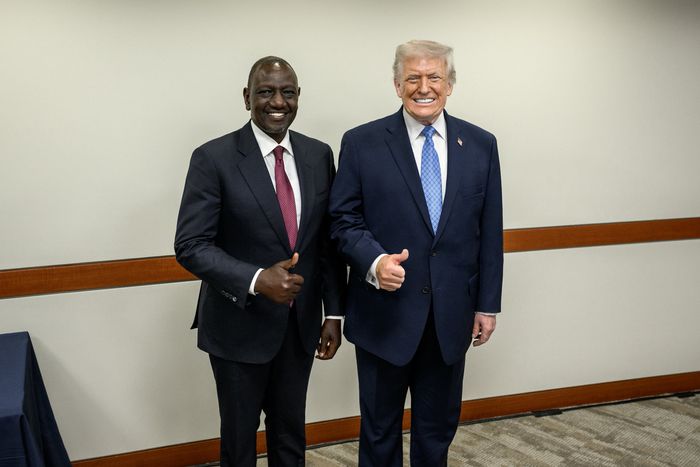
Kenya currently finds itself entangled in a geopolitical trade-off that threatens the very foundation of its national autonomy. In late 2025, the Kenyan government entered into a USD 2.5 billion (Ksh. 322 billion) Health Cooperation Framework with the United States.
While the deal is framed as a critical intervention for a struggling healthcare sector, its underlying terms reveal a troubling surrender: the exchange of seven years of Kenyan health data for financial survival. This agreement is not merely a partnership; it is a symptom of a deeper crisis in data sovereignty.
The urgency of this deal was born from a sudden vacuum left by the United States Agency for International Development (USAID). Following a shift in U.S. foreign policy in early 2025, USAID funding for Kenyan digital health platforms was abruptly suspended. According to reports from TechCabal, this funding freeze was part of a broader America First strategy that saw the Trump administration cancel roughly 83% of USAID programs and move to dismantle the agency entirely, citing mismanagement and a lack of results.
For years, these platforms, which manage everything from Electronic Medical Records (EMRs) to national disease surveillance, were funded by U.S. grants and hosted on servers owned by private American corporations like Amazon Web Services (AWS) and Microsoft. When the funding ceased, Kenya discovered a harsh reality: control did not belong to the state.
Because the infrastructure was built on foreign-owned proprietary clouds, the Kenyan government found its own health data in a state of limbo. Hospitals were unable to access long-term patient trends, and the national supply chain for critical medications faced disruption. The BBC reports that the Kenyan health system was effectively folding in on itself, with over 41,000 health workers facing layoffs and antiretroviral (ART) clinics closing. It was a stark demonstration that when a nation’s digital architecture is outsourced, its sovereignty exists only at the pleasure of the financier.
This is not the first time Kenya has been locked out of its own critical information. The 2017 General Election serves as a haunting precedent for the current health data crisis.
During the historic petition to nullify the presidential election, the Supreme Court ordered an audit of the servers managed by the French firm OT-Morpho. The Independent Electoral and Boundaries Commission (IEBC) famously stalled, arguing that they did not have full administrative access. The French company maintained that the server architecture was their intellectual property and they refused to grant access.
The implication was staggering: the democratic will of the Kenyan people was stored in a “black box” that the Kenyan state itself could not open. This established a dangerous pattern where foreign private entities hold more power over Kenyan national data than the Kenyan judiciary.
The 2025 health agreement attempts to use legal language to mask a lopsided reality. While the pact asserts Kenyan ownership, it grants the U.S. government access to analyse and utilize seven years of disease surveillance and system data.
The parallels between the 2017 election crisis and the 2025 health bailout are undeniable:
- Dependency: Vital national systems are built using foreign tech and foreign money.
- Hosting: Data is stored on servers outside the physical and legal jurisdiction of Kenya.
- Access: In times of crisis, the Kenyan state is a secondary user of its own information.
Under the new America First Global Health Strategy, Kenya was the first African country to sign this bilateral framework. While the deal promises USD 1.6 billion (Ksh. 206 billion) in direct government-to-government support, bypassing NGOs to supposedly strengthen local institutions, it also creates a mechanism for the cross-border transfer of health data that critics warn lacks clear accountability.
Kenya’s health data is a strategic national asset, containing the genetic and clinical history of its population. By trading this data for short-term budgetary relief, the state risks a new form of digital colonialism, where the Global North mines the Global South for the raw material of the 21st century: information.
True sovereignty in the modern age requires more than just a flag and a constitution; it requires the physical ownership of the servers and the code that run the country. Until Kenya invests in its own sovereign cloud infrastructure, a move the government has belatedly prioritized following the USAID cuts, it will continue to be a tenant in its own house, forced to pay for access to its own history.